Streaks on dishes from the dishwasher: the 4 causes and the definitive fix
Dull glasses, drops on cutlery, rough plates: in a professional dishwasher, streaks almost always come from one of these 4 causes. How to spot them in two minutes and fix them for good.
Redazione Lüster — 4F Services · Verified on: 2026-09-12
A dull glass held against the light is the fastest way to lose an attentive guest — and the frustration for whoever washes is real: "the machine washes, but you can't tell." The good news: in a professional dishwasher, streaks are never a mystery. They almost always come from one of these four causes, and each has a precise remedy.
Cause 1 — The detergent dose does not match your water
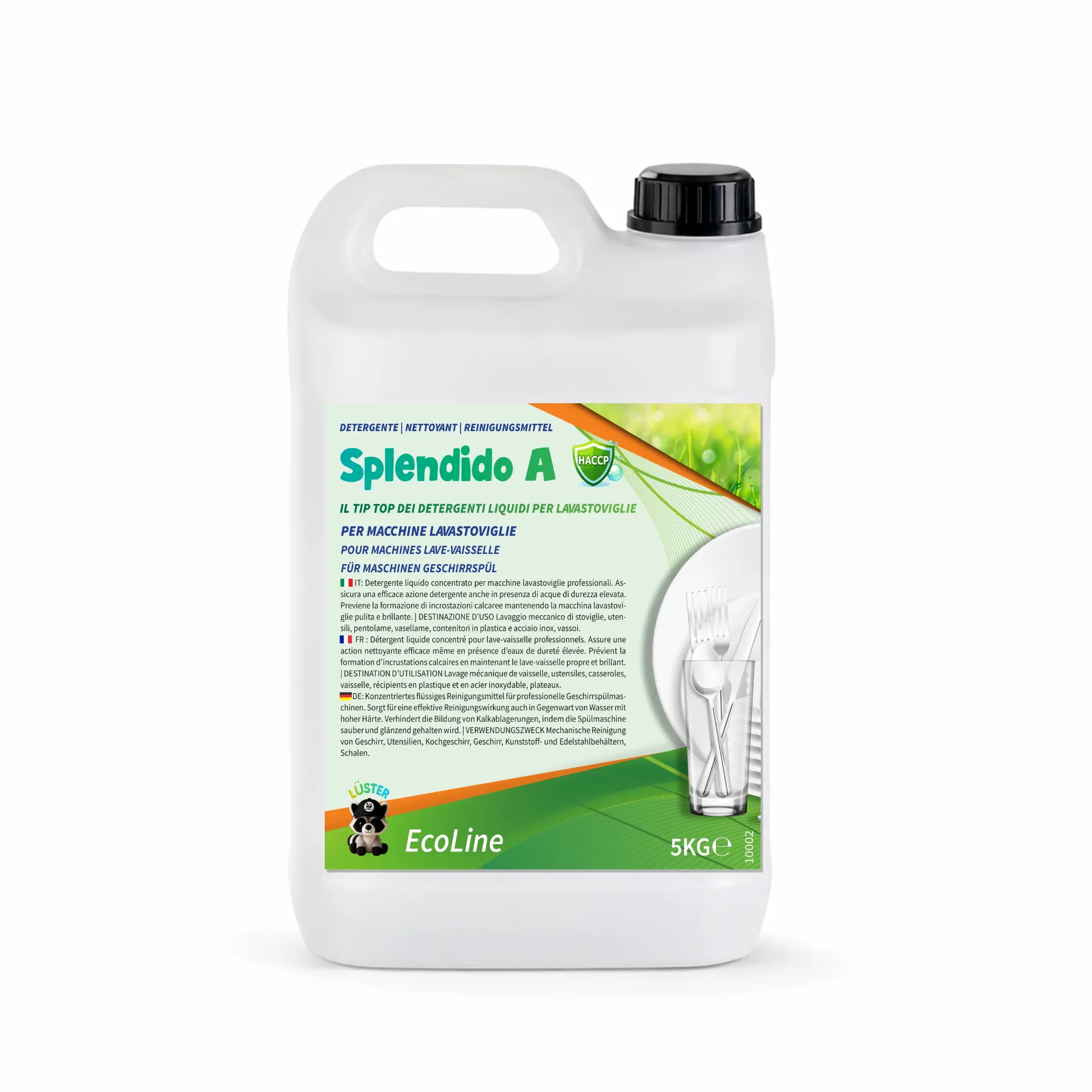
The most frequent cause. Dishwasher detergent is dosed according to water hardness: soft water needs just 2 g/L, medium water 3 g/L, hard water — most of Switzerland and Ticino — requires 4–5 g/L. If the dosing unit is still on the factory setting, with hard water the detergent is neutralised by limescale before it can wash: dishes come out "clean but veiled". Your local water utility publishes the hardness for your area.
Cause 2 — The rinse aid is empty or badly adjusted
Drops that dry on glass leaving their limescale ring are the signature of rinse aid: either it has run out, or the dose is too low for your water. Professional rinse aid works at tiny but decisive doses — for DaBrill, for example, 0.2 ml/L in soft, 0.35 ml/L in medium, 0.5 ml/L in hard water — and at those doses one container lasts thousands of litres of solution. If the rinse-aid doser is never checked, results change from one week to the next for no apparent reason.
Cause 3 — The machine is already scaled up
If heating elements and spray arms are covered in limescale, the machine no longer reaches the correct temperature and pressure: washing weakens and residues settle again. The typical sign is a gradual decline over weeks, not overnight. The remedy is a descaling cycle with a specific product (for example No Calc L, 100 ml per litre of water, 10–20 minutes of contact followed by an empty cycle), then monthly preventive maintenance. We cover this in detail in the twin article on machine care.
Cause 4 — Wrong loading and pre-treatment
Dishes wedged together, overfilled racks, solid residues not removed: water cannot reach where it should and dirt moves around instead of leaving. The professional cycle lasts 60–90 seconds: there is no time to "fix" a bad load. The rule is simple: scrape off the bulk, place everything upright, overlap nothing.
The two-minute check before calling service
- Hold a glass against the light: even haze = detergent or limescale; drop rings = rinse aid.
- Open the machine at the end of the cycle: white film on the walls = descaling needed.
- Check the dosers: both must draw; a detached hose voids any setting.
- Check the softener salt, if fitted: an empty tank means hard water running free in the machine.
The lasting fix: a system, not a single product
Those who remove streaks "once" find them again a month later, because the cause is always the combination of water + dosing + machine condition. That is why the dishwasher is managed as a system: detergent dosed on real hardness (Splendido A for medium and hard water, Splendido C where automatic dosing is already optimised), rinse aid adjusted to the same water (DaBrill) and scheduled periodic descaling (No Calc L). Three settings done once, then only a weekly level check. You will find all data sheets with dosages on the Documents page, and the full verification path in the dishwasher check-up in the Guide.
Source and references: Schede tecniche (FT) e schede di sicurezza (SDS) Lüster dei prodotti citati; durezza delle acque: dati dei gestori idrici comunali e SVGW.
The other side of the counter: read the mirror version of this article
Try the tool linked to this article
This article is for information only and does not replace the product label and Safety Data Sheet (SDS), which remain the only binding reference. Before use, always read the label and SDS on the nav.documents
The products mentioned in this article