Limescale in the dishwasher: the maintenance that extends the machine's life
You do not see limescale until it does damage: scaled heating elements, rising consumption, weak washing. The right periodic maintenance — what to do, how often, at which doses.
Redazione Lüster — 4F Services · Verified on: 2026-09-12
A professional dishwasher costs as much as a small car and works more hours than one. Yet in many kitchens, maintenance starts when it stops. The culprit is almost never a sudden failure: it is limescale, working silently for months before presenting the bill — and across much of Switzerland, where water is medium or hard, the match has already begun.
What limescale really does to the machine
Limescale settles first where water is heated: heating elements, boiler, wash circuits. The damage is twofold. The first is energetic: technical literature indicates that 1 mm of limescale on the heating element can raise energy consumption by about 18%, because the deposit insulates the element from the water it must heat. The second is mechanical: partially clogged nozzles reduce wash pressure, seals work on rough surfaces and wear out sooner, the pump strains. The visible result — dull dishes, longer cycles — arrives when the invisible damage is already advanced.
The signs that the machine is scaling up
- White or rough film on walls, door and racks, even right after washing.
- Growing streaks on dishes with no product change (the signal linking this article to its twin).
- Longer heating times or wash temperature struggling to reach level.
- Weak or irregular jets from the spray arms.
- A different pump sound: more effort, more vibration.
Periodic maintenance: what to do and how often
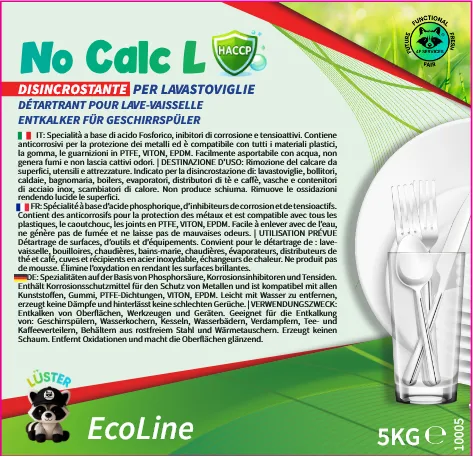
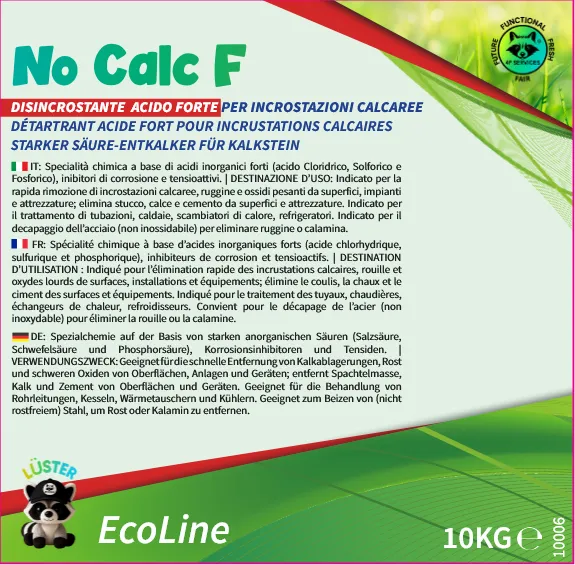
The professional rule is simple: monthly descaling with a specific product, more often if the water is very hard or daily cycles are many. The procedure with a dedicated acid descaler (No Calc L): maintenance dilution of 100 ml per litre of water — yielding 10 litres of solution — or intensive dilution of 200 ml per litre for tougher build-up; contact time of 10–20 minutes, then a full empty cycle before returning to service. For those who prefer the powder version, No Calc F covers the same maintenance. Two non-negotiable safety rules: gloves and goggles while preparing (it is an acid product — the safety data sheet is on the Documents page) and never mix with chlorinated products.
What does not help, on the contrary
- Vinegar or household acids: unpredictable doses, fragrances incompatible with food contact, no guarantee on machine materials.
- Descaling "when you can see it": by the time limescale is visible to the eye, elements and circuits already hold more, where you cannot see.
- Increasing the detergent to compensate: masks the symptom, accelerates the problem and wastes product on every cycle.
The minimal plan that works
Mark it on the cleaning plan: descaling on the first Monday of the month (or every two weeks with very hard water), weekly check of softener salt and doser levels, visual inspection of the spray arms. Three habits that cost a few minutes and add years to the machine's working life, keeping power consumption and wash quality steady. To tailor the plan to your specific machine, the dishwasher check-up in the Guide walks you through step by step — and for any dosing question, the data sheets of the products mentioned are always on the Documents page.
Source and references: Schede tecniche (FT) e schede di sicurezza (SDS) Lüster dei prodotti citati; dati di letteratura tecnica sull'effetto del calcare sul rendimento termico delle resistenze.
The other side of the counter: read the mirror version of this article
Try the tool linked to this article
This article is for information only and does not replace the product label and Safety Data Sheet (SDS), which remain the only binding reference. Before use, always read the label and SDS on the nav.documents