
Poor sanitation and persistent odours? Common mistakes ClorUP helps solve
Wrong dilution, short contact times and lingering odours are common issues. Here is how ClorUP helps address them in practice.
Mistake 1: using one dilution for every task
A common issue with hygienisers and sanitisers is using the same concentration regardless of the level of soiling or the area being treated. While simple, this approach can reduce operational accuracy and lead to inconsistent results.
ClorUP addresses this with two clear working dilutions: 20 ml per 1 litre of water for routine use and 50 ml per 1 litre for intensive applications. Local water hardness should also be considered for more reliable professional use.
Mistake 2: cutting the contact time short
In fast-paced cleaning operations, products are often removed too quickly. This is a typical mistake, because insufficient dwell time can limit the quality and consistency of sanitation.
With ClorUP, the method is clearly defined: leave for 5 minutes, then remove with a clean cloth or rinse with water. This helps ensure the active chlorine can deliver its intended hygienising, deodorising and whitening action.
Mistake 3: masking odours instead of treating the source
Persistent odours are often handled with surface-level interventions only. In work environments and on equipment, that is rarely enough when the source of the odour remains untreated.
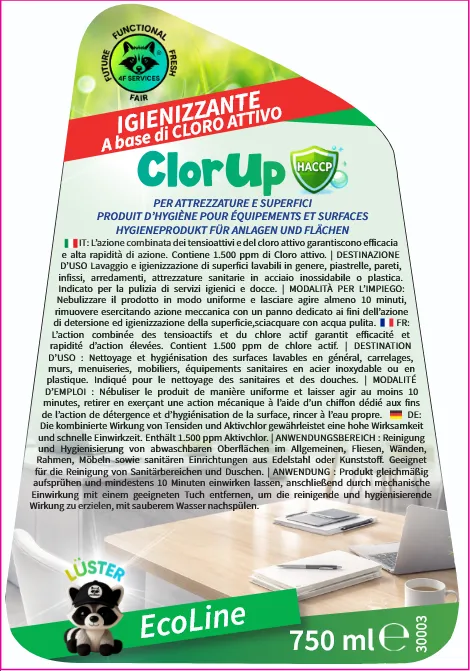
ClorUP is designed to eliminate odours at the source while also providing deep sanitation and deodorising action. This makes it especially useful in daily routines where hygiene control is part of the service standard.
Mistake 4: overlooking grout lines and light-coloured surfaces
Grout lines and light surfaces tend to show dullness and visible loss of cleanliness very quickly. A frequent mistake is to treat them with a general approach without considering the need for a whitening effect.
ClorUP helps with a specific whitening action on grout and light-coloured surfaces in addition to its sanitising performance. Used daily with a cloth, sponge or professional tool, it supports more stable visual and hygiene standards.
FAQ
What is the most common mistake when using a chlorine-active sanitising detergent?
The most common mistakes are incorrect dilution and not allowing enough contact time. With ClorUP, use 20 ml/L for routine work, 50 ml/L for intensive work and allow 5 minutes.
Can ClorUP help with persistent bad odours?
Yes. One of its key strengths is eliminating odours at the source while also providing hygienising and deodorising action.
Where is ClorUP especially useful when visual cleanliness matters?
It is particularly useful on grout lines and light-coloured surfaces, where its whitening action can support a cleaner overall appearance.