
How to clean anti-slip porcelain stoneware without damaging it
Anti-slip porcelain stoneware traps dirt in its micro-roughness: here is the right method, the right dilution and the mistakes to avoid.
Why anti-slip stoneware gets so dirty
The micro-rough surface that makes anti-slip stoneware safe is also its weakness: greasy dirt and limescale residues settle into the micro-ridges and a too-light daily wash does not remove them. Over time the floor looks grey even after mopping.
The good news: you don't need to scrub harder, you need the right product with the right contact time.
The right method in 4 steps
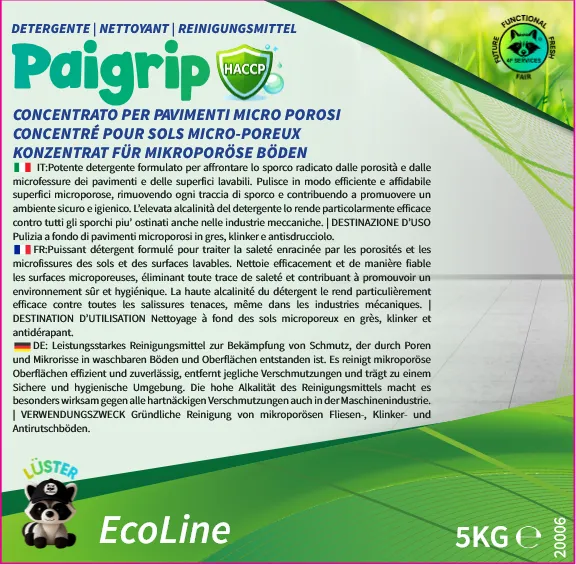
1) Sweep or vacuum to remove dust and sand. 2) Dilute Paigrip at 5–10% in warm water (50–100 ml per 10 litres). 3) Spread and leave to act for 3–5 minutes without letting it dry. 4) Work with a microfibre mop or single-disc machine, then rinse with clean water.
In professional kitchens or workshops, where the dirt is greasy, use a single-disc machine with a medium pad: the mechanical action lifts the dirt out of the micro-ridges.
Mistakes to avoid
Do not use waxes or self-polishing products on anti-slip stoneware: they fill the micro-ridges and make the floor slippery. Do not exceed the dose: more product does not mean cleaner, only more residues. Do not use black abrasive pads: they scratch the glaze.
Daily maintenance after the deep clean
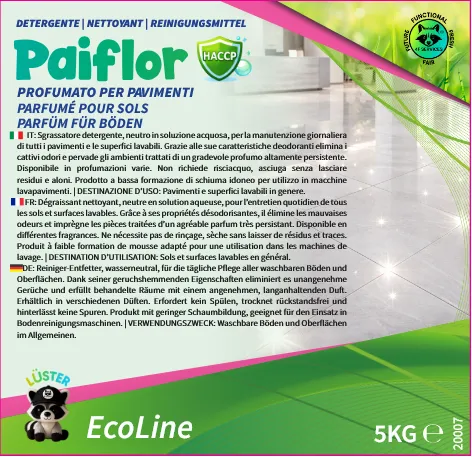
After the deep clean with Paigrip, maintenance becomes easy: Paiflor at 3–5% every day, no rinsing. With Switzerland's hard water, consider a descaling pass once a month to keep the shine.
FAQ
How often does anti-slip stoneware need a deep clean?
In professional settings (kitchens, workshops) once a week or as needed; at home or in offices once a month is enough, with daily maintenance at a light dilution.
Can Paigrip be used in a scrubber dryer?
Yes: diluted at 5–10% it is compatible with professional scrubber dryers. For heavy dirt, do a first pass applying solution only, leave to act, then pass again with suction.
Can stoneware damaged by old waxes be recovered?
In most cases yes: a strong alkaline deep clean (Paigrip 10%, 10 minutes contact time, mechanical action) removes wax residues. Extreme cases need two passes.