
Spots on dishes from the dishwasher? Common mistakes and how DaBrill helps solve them
Spots, droplets or slow drying? Discover common professional dishwasher mistakes and how DaBrill helps correct them.
Mistake 1: underestimating the role of rinse aid
When glassware and stainless steel come out with droplets or marks, the cause is often looked for only in the wash stage. In professional dishwashing, however, the rinse aid stage is essential for final drying and for the visual finish of items leaving the machine.
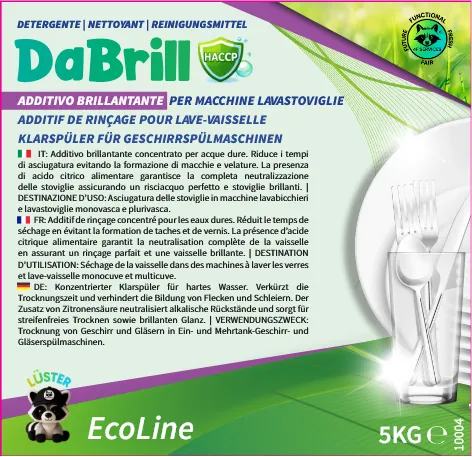
DaBrill is designed for exactly this task. It is a concentrated rapid-drying rinse aid for professional dishwashers with a dosing unit, helping reduce marks and droplets on glass and stainless steel while speeding up return to service.
Mistake 2: using a dosage that does not match water hardness
One of the most common mistakes is keeping the same setting regardless of water conditions. If dosage does not match actual water hardness, drying can become less even and visible spotting may remain, especially on glassware and stainless steel surfaces.
DaBrill gives clear reference points: 0.2 ml/L for soft water, 0.35 ml/L for medium water and 0.5 ml/L for hard water. Setting the dosing unit accordingly helps the product work more effectively, including in sites where hard water makes visual finish more demanding.
Mistake 3: neglecting the dosing unit, nozzles and routine checks
Not every finishing issue is caused by the product itself. In many cases, the source is mechanical or linked to routine maintenance. A dosing unit that has not been checked, or dirty nozzles, can affect how rinse aid is delivered and make results less consistent.
That is why correct use of DaBrill includes three simple steps: check the dosing unit, run the full wash cycle and inspect product level and nozzle cleanliness weekly. These actions help maintain stable day-to-day performance.
Mistake 4: focusing only on immediate consumption instead of total output
In professional operations, attention often goes first to short-term consumption. With rinse aids, real output also matters. A product that performs with accurate micro-dosing can support service continuity more effectively than one requiring heavier or less precise dosing.
DaBrill offers a practical advantage here: one 5 kg pack can last for thousands of cycles when set correctly. With outputs up to 25'000 L in soft water, 14'000 L in medium water and 10'000 L in hard water, it combines visual performance with efficient product management.
FAQ
Why do dishes come out with droplets even when the cycle is correct?
A common reason is the rinse aid stage: incorrect dosage, a dosing unit not adjusted to water hardness or nozzles that need checking. DaBrill is designed to support fast drying and reduce visible marks and droplets.
Should settings be changed for hard water?
Yes. Dosage should match water hardness. For DaBrill, the reference is 0.5 ml/L in hard water, 0.35 ml/L in medium water and 0.2 ml/L in soft water.
How can I improve result consistency?
Check the dosing unit, use DaBrill at every wash and inspect product level and nozzle cleanliness weekly. This routine helps keep drying performance more stable.