
Stubborn limescale on machines and surfaces? Common mistakes and how No Calc F helps solve them
Dilution, contact time and surface choice: common descaler mistakes and how to use No Calc F correctly.
Mistake 1: treating limescale like ordinary soil
One of the most common mistakes is trying to remove layered limescale with products or methods meant for routine cleaning. When scale builds up over time, a descaler needs to work deep into the deposit rather than only on the surface.
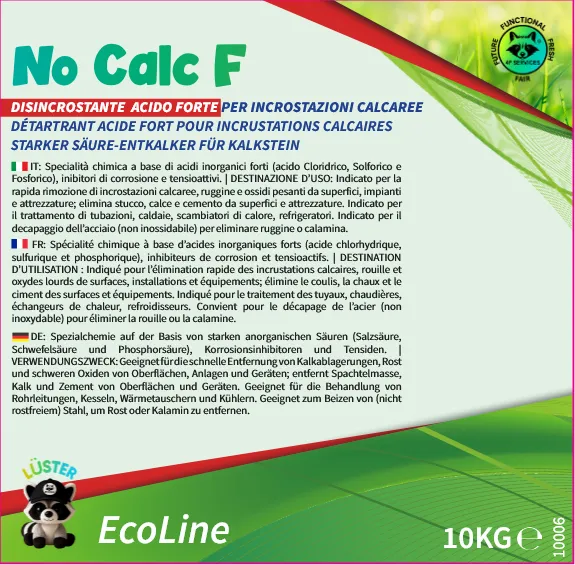
That is exactly where No Calc F fits: it is a strong acidic descaler for machines and surfaces, designed to dissolve stubborn limescale deposits, including layered build-up.
Mistake 2: using the same dilution every time
Another frequent issue is failing to distinguish between routine maintenance and intensive descaling. A dilution that is too light can slow down work on tough deposits, while a dosage that does not match the situation does not improve the process.
With No Calc F, dosing is straightforward: 100 ml per 1 L for ordinary use, yielding 10 L, or 200 ml per 1 L for intense use, yielding 5 L. The right choice depends on the level of scaling and local water hardness.
Mistake 3: not respecting contact time
In daily operations, products are sometimes removed too early or the dwell time is not properly built into the task. The result can be incomplete descaling and the need for a repeat treatment.
For No Calc F, the stated contact time is 5 to 15 minutes. Staying within that range helps the product act effectively on the deposits. After the contact time, the solution should be removed with a clean cloth or rinsed with water.
Mistake 4: applying it to the wrong surface or waiting too long
Acidic descalers are not universal products. A technical mistake is using them without checking whether the surface is acid-resistant. Another is waiting until scale build-up is already affecting machine performance before taking action.
No Calc F is intended for acid-resistant surfaces, dishwashers, boilers and equipment. Adding it to a monthly maintenance routine, or adjusting frequency according to soil load, helps limit heavy build-up and supports the restoration of machine efficiency.
FAQ
Why does limescale come back quickly?
If descaling is only occasional or not matched to the actual level of build-up, limescale tends to return quickly. A monthly frequency or a schedule based on soil level helps keep it under better control.
When should the intense dilution of No Calc F be used?
The intense dilution, 200 ml per 1 L with a 5 L yield, is suitable when deposits are especially stubborn or already layered.
Can No Calc F be used on equipment?
Yes, it is suitable for equipment, dishwashers, boilers and acid-resistant surfaces. Material compatibility with an acidic descaler should always be checked before use.