
Stubborn limescale on stainless steel and equipment? Common descaler mistakes and how FosfoKal helps solve them
Wrong dilution, poor contact time and delayed maintenance are common descaler mistakes. Here is how FosfoKal helps address them.
Mistake 1: using the wrong dilution for the level of build-up
One of the most common mistakes with descalers is treating every deposit the same way. Light limescale, consolidated mineral residues and heavily layered build-up do not require the same treatment intensity, and an arbitrary concentration often slows the job down.
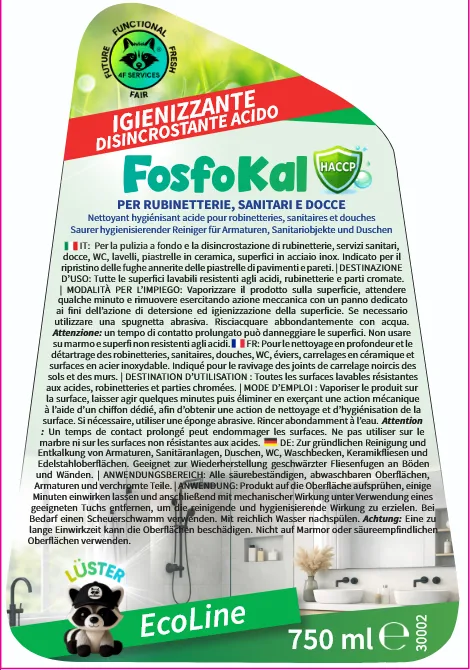
FosfoKal addresses this with two clear operating references: 100 ml per 1 litre of water for ordinary scale and 200 ml per 1 litre for intensive work. The choice should always reflect the level of build-up and local water hardness.
Mistake 2: not respecting contact time
Another frequent problem is removing the product too soon or leaving it on without a defined method. In both cases, results can become inconsistent: if contact time is too short, deposits are not loosened effectively; if the method is uncontrolled, process consistency suffers.
With FosfoKal, the indicated contact time is clear: 5 to 15 minutes. This range makes it possible to match the treatment to the level of scale while keeping the process simple, repeatable and professional.
Mistake 3: adding extra steps when one is enough
In practical operations, descaling and hygienising are often separated unnecessarily, increasing time, handling and product use. When the chosen product does not cover both needs, the cleaning cycle becomes heavier than it needs to be.
FosfoKal combines descaling and hygienising action in one step. This is especially useful on stainless steel, equipment and circuits where teams need straightforward procedures that are easy to apply consistently.
Mistake 4: waiting until scale is heavily layered
Many difficult descaling jobs are the result of maintenance being left too long. When limescale builds up week after week, removal takes more time and often more mechanical effort, directly affecting operational efficiency.
FosfoKal is intended for weekly use and remains effective on heavily layered limescale. A regular routine helps prevent major build-up and keeps stainless steel surfaces, equipment and circuits under better control.
FAQ
Can FosfoKal handle old, heavily layered limescale?
Yes. One of its stated strengths is effectiveness on limescale, even when it is heavily layered. In these cases, the right dilution and the recommended contact time are important.
Why does local water hardness matter?
Because the use instructions specify diluting the concentrate while respecting local water hardness. This helps adapt the treatment to real operating conditions.
Does FosfoKal always need a final rinse?
After the contact time, the product should be removed with a clean cloth or rinsed with water. The appropriate choice depends on the treated surface and the working method.