
Streak-free glass: the professional method in 4 moves
Streaks, dried drops and grey haze don't depend on the cloth but on product, technique and water. Here's how cleaning companies work — and the right product to use.
Why glass stays streaky
Three causes cover 95% of cases: too much product (surfactant residue forms the grey haze), water too hard that leaves limescale as it dries, and dirty cloths or cloths treated with fabric softener that hold grease instead of removing it.
Timing matters too: glass in direct sunlight evaporates water too fast and fixes drops before you can dry. Work early in the morning or in the shade.
The professional method in 4 moves
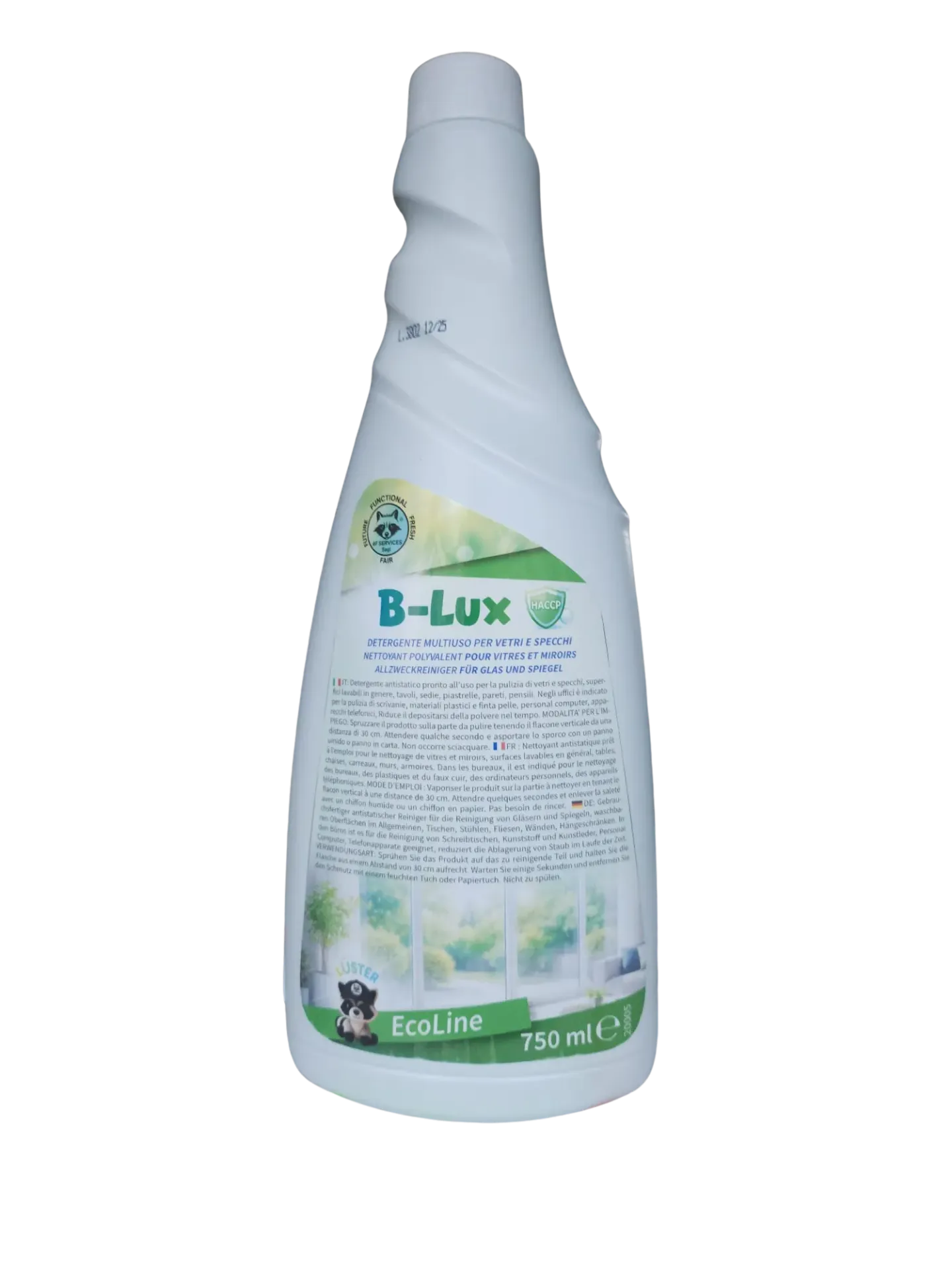
1) Dust frame and corners with a dry cloth: wet dry dirt turns to mud. 2) Spray the glass detergent — B-Lux ready-to-use in the 750 ml bottle — evenly, without excess. 3) Work with a glass microfibre cloth in S-strokes, top to bottom. 4) Finish with a dry cloth or squeegee: one pass per strip, blade always clean.
On large glazed surfaces the professional squeegee beats any cloth: after spreading, pull the blade at 45° in one continuous motion and wipe the blade after each pass.
Hard water: the Swiss problem par excellence
In Switzerland, and especially in Ticino, water is very hard: limescale residue is the leading cause of haze on showers, shop windows and windows. A professional glass detergent like B-Lux contains agents that counter limescale deposits; for existing build-up you first need a descaling pass, a rinse, and only then the finishing.
Rule of thumb: if you see white dried drops, it's not greasy dirt — it's limescale. Glass detergent alone is not enough: treat first with a specific descaler.
Mistakes that cost time (and customers)
Newspaper and paper towels leave lint and ink. Sponge cloths just move dirt around. Dosing 'by eye' from the concentrate bottle leaves residue: always follow the label. And never mix different detergents on the same glass: incompatible surfactants create rainbow streaks that can't be removed without re-washing everything.
FAQ
Microfibre cloth or squeegee — which is better?
Up to patio-door size, the glass microfibre cloth is faster and handier. For shop windows and glazed facades the professional squeegee is irreplaceable: fewer passes, zero lint, uniform result.
Does B-Lux need diluting?
No: B-Lux is ready-to-use in the 750 ml spray bottle. Spray, spread with microfibre and dry. On vertical surfaces spray onto the cloth to avoid drips.
How do I remove rainbow streaks from glass?
Almost always product residue: re-wash the glass with very little well-spread detergent and dry immediately with a clean, dry microfibre cloth. If they persist, there is limescale underneath: a descaling pass is needed first.